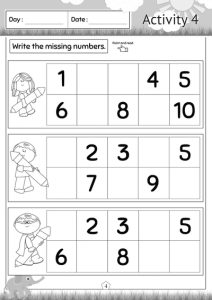
Mastering basic numeracy skills by age six is critically important as it provides the foundational bedrock for all future academic success, not just in mathematics but across various subjects. Numeracy, which goes beyond simple counting, involves understanding patterns, developing spatial awareness, and strengthening problem-solving and logical reasoning skills. Strong early math skills are a better predictor of later school achievement than early reading skills. By developing confidence in working with numbers and quantities in their daily lives, children are better equipped to make sense of the world, analyze information, and prepare for the more complex mathematical concepts and STEM fields they will encounter in the future.
For children aged six, the numeracy curriculum typically focuses on solidifying number sense and introducing basic operations. Key concepts include counting reliably to at least 100, and often beyond, and understanding place value (e.g., in a two-digit number, recognizing the tens and ones places).4 They should master simple addition and subtraction within 20, often using objects or drawings, and begin to understand the idea of skip counting (by 2s, 5s, and 10s) as an introduction to multiplication. Additionally, they should be able to recognize and name common 2D and 3D shapes, understand measurement (comparing length, weight, and capacity), and begin to tell time (to the hour and half-hour) and recognize money denominations.