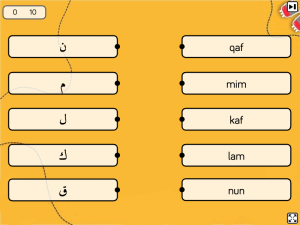
Matching the Arabic alphabet with its corresponding transliteration (Latin script representation) serves as a vital bridge for young learners, particularly those whose native language uses the Roman alphabet. It allows children to immediately connect the unfamiliar Arabic characters with familiar phonetic sounds, overcoming the initial hurdle of a completely new script. This phonetic aid helps children correctly pronounce the Arabic letters, especially the sounds that don’t exist in English, which in turn solidifies the crucial link between the letter’s shape and its precise sound, leading to faster and more confident letter recognition.
While transliteration is a temporary tool, its early use helps build a strong foundation for reading fluency and spelling accuracy. By establishing a consistent, one-to-one mapping between the written Arabic letter (the grapheme) and its Latin equivalent, the child gains a reliable reference point. This technique can speed up the early learning process, enabling the child to move quickly from isolated letters to recognizing and pronouncing entire words, which is essential for advancing to non-transliterated texts, such as the Quran. The goal is to gradually phase out the transliteration as the child achieves automatic recognition of the native Arabic script.