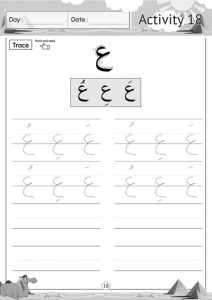
Practicing tracing the Islamic Hijaiyyah characters (Arabic alphabet) is a fundamental step in a child’s early religious and literacy education. This tactile activity helps young learners develop crucial fine motor skills and hand-eye coordination, which are essential for future handwriting proficiency. By repeatedly tracing the unique curves and strokes of letters like alif, baa, and taa, children begin to build a visual and muscle memory of the letter shapes. This foundational recognition is key to smoothly transitioning into reading the Qur’an and other Arabic texts, ensuring they can correctly identify and form the characters necessary for vocalizing the sounds and ultimately understanding the holy script.
Beyond the physical and cognitive benefits, tracing the Hijaiyyah characters instills a sense of familiarity and reverence for the Arabic script, which holds immense significance in the Islamic faith as the language of the Qur’an. This early exposure makes the process of learning to read the Qur’an less daunting later on, fostering a positive and engaging introduction to religious study. It lays the groundwork for correct tajwid (pronunciation) and recitation, as a child who accurately recognizes the shape of the letter is better prepared to produce its correct sound. Essentially, tracing serves as a practical, engaging, and spiritually meaningful starting point for a child’s lifelong journey with the sacred text.