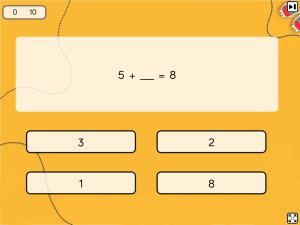
A child’s ability to solve simple addition and subtraction problems with a missing number (e.g., $4 + \_\_ = 7$ or $9 – \_\_ = 5$) is fundamentally important as it fosters algebraic thinking at an early age. This skill moves the child beyond mere calculation and introduces the concept of an unknown variable and relationship of equality. To find the missing number, the child must understand that addition and subtraction are inverse operations . For instance, to solve $4 + \_\_ = 7$, they must realize they can use subtraction ($7 – 4 = 3$). This demonstrates a deeper conceptual understanding of how numbers relate to each other within an equation, which is far more advanced than simply finding the sum or difference.
Mastering missing-number problems is a crucial step in developing problem-solving strategies and flexibility in arithmetic. It trains the child to think strategically about the structure of an equation and what operation is needed to isolate the unknown value. This foundational competence is essential preparation for later mathematics, where equations routinely contain unknowns represented by letters. By practicing these simple versions, a child builds the analytical skills required to transition smoothly into formal algebra, where they will systematically manipulate equations to solve for variables. This makes the skill a vital early bridge between basic arithmetic and higher-level mathematical reasoning.