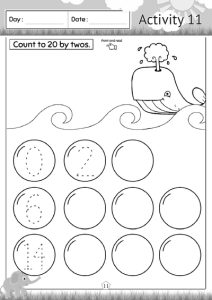
Mastering numeracy at age five is crucial for laying the foundation for all future academic success and for developing essential life skills. Mathematical ability in the early years has consistently been shown to be a stronger predictor of overall school achievement, including literacy, than other factors. Early exposure to numbers and mathematical concepts helps children develop logical thinking, critical problem-solving skills, and spatial awareness, enabling them to make sense of the world around them, from noticing patterns in nature to understanding quantities when sharing toys or food. A strong start prevents later math anxiety and builds confidence that extends into other learning areas.
The numeracy curriculum for 5-year-olds should focus on experiential, play-based learning to cover fundamental concepts. Core areas include Number Sense and Counting, where children learn rote counting (saying numbers in order) up to 20 or beyond, practice one-to-one correspondence (matching one number to one object when counting), and develop cardinality (understanding that the last number counted represents the total quantity). It should also cover Early Arithmetic, introducing concepts of addition and subtraction using small quantities and concrete objects. Finally, the curriculum must include Measurement and Geometry, focusing on identifying basic 2D and 3D shapes (like circles, squares, and cubes), using comparative language (taller/shorter, heavier/lighter), and exploring patterns (e.g., repeating sequences of colors or shapes).